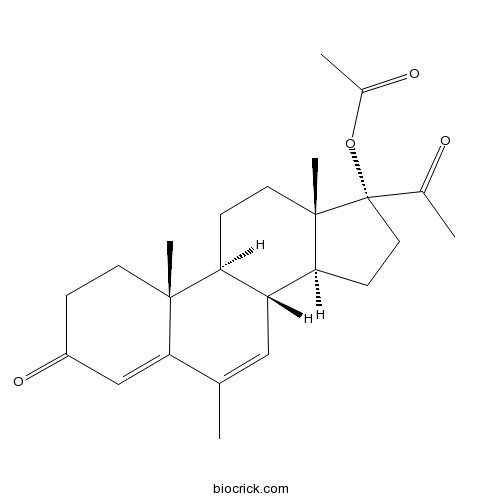
Megestrol caproate, abbreviated as MGC, is a progestin medication which was never marketed. It was developed in Russia in 2002. In animals, MGC shows 10-fold higher progestogenic activity compared to progesterone when both are administered via subcutaneous injection. In addition, MGC has no androgenic, anabolic, or estrogenic activity. The medication was suggested as a potential contraceptive and therapeutic agent.
Chemistry
Megestrol caproate, also known as megestrol 17α-caproate, as well as 17α-hydroxy-6-dehydro-6-methylprogesterone 17α-caproate or as 17α-hydroxy-6-methylpregna-4,6-diene-3,20-dione 17α-caproate, is a synthetic pregnane steroid and a derivative of progesterone and 17α-hydroxyprogesterone. It is the C17α caproate (hexanoate) ester of megestrol. Closely related medications include megestrol acetate (MGA; megestrol 17α-acetate), acetomepregenol (megestrol 3β,17α-diacetate), and cymegesolate (megestrol 17α-acetate 3β-cypionate). In addition to MGA, analogues of MGC include chlormadinone caproate, gestonorone caproate, hydroxyprogesterone caproate, medroxyprogesterone caproate, and methenmadinone caproate.
See also
- List of Russian drugs
References