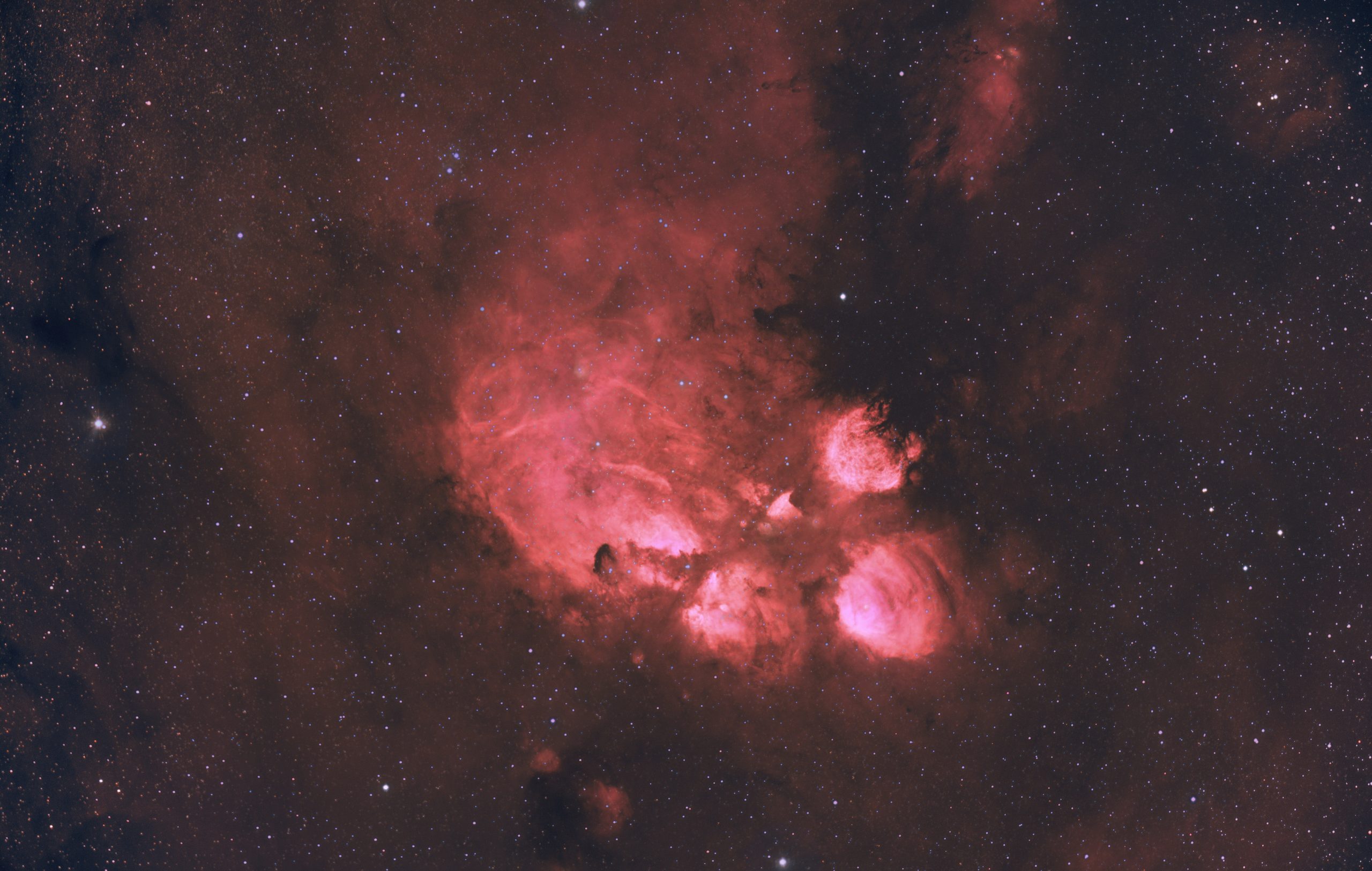
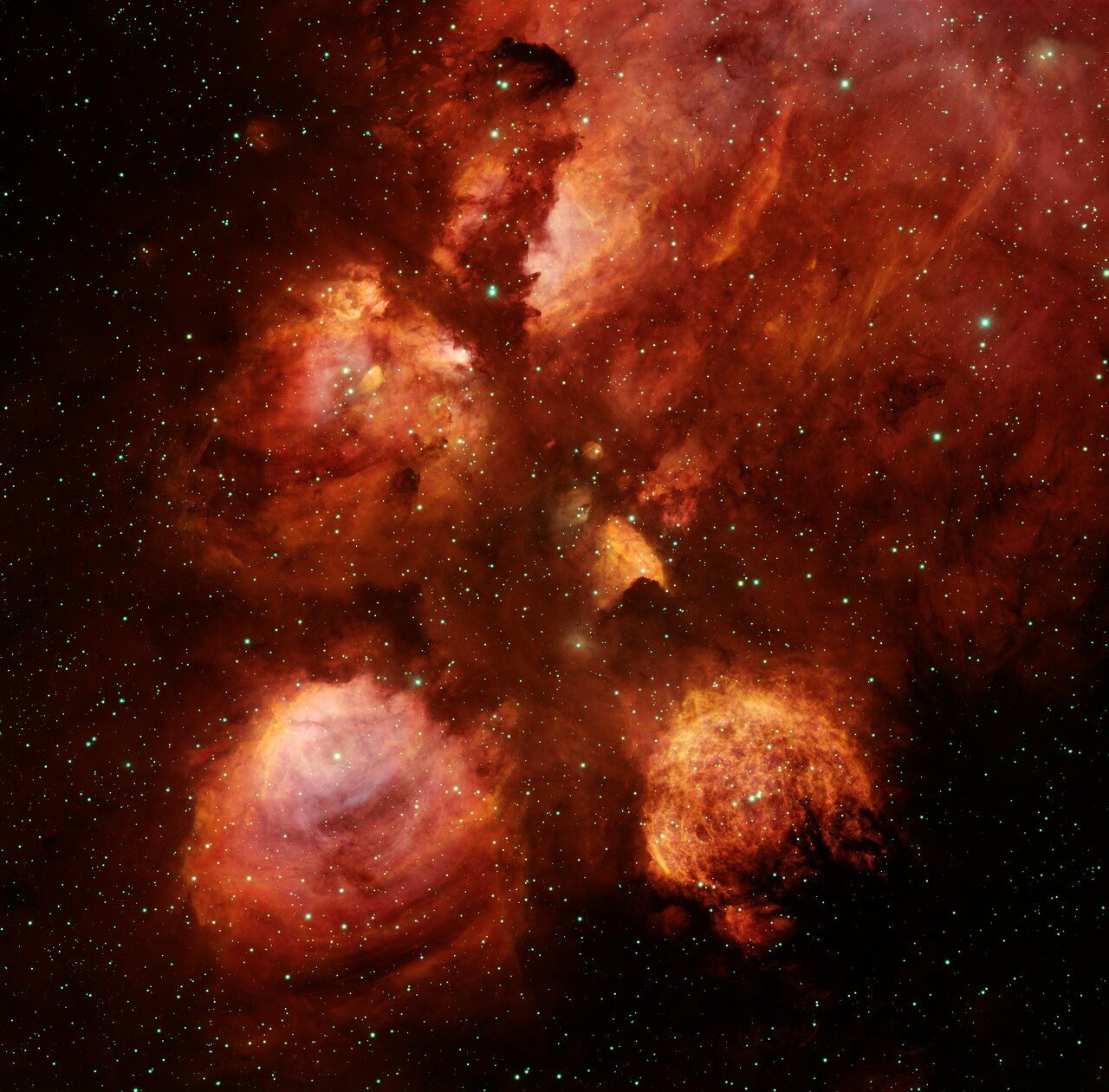
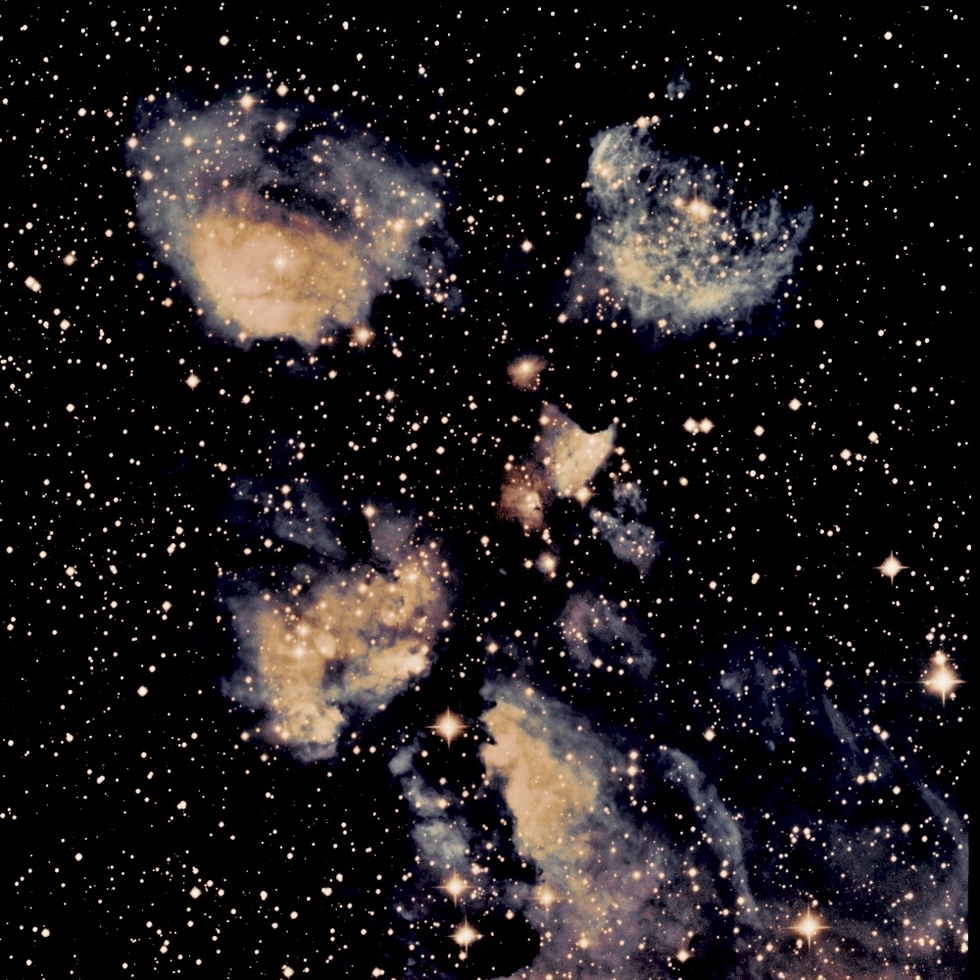
NGC 6334 is a massive emission nebula and star-forming region located in the constellation Scorpius. It is colloquially known as the Cat's Paw Nebula, and can be found 3° to the west-northwest of the bright star Lambda Scorpii. NGC 6334 was discovered by English astronomer John Herschel on June 7, 1837, who observed it from the Cape of Good Hope in South Africa. It spans an angular area larger than the full Moon. This structure is located in the Carina–Sagittarius Arm of the Milky Way, at a distance of approximately 5.5 thousand light-years from the Sun.
This nebula is a high mass filamentary cloud structure spanning ~320 ly. In the visible part of the spectrum, NGC 6334 emits mainly in red (from hydrogen atoms) and blue (from oxygen atoms). The interior is heavily obscured by interstellar dust, with clumps ranging up to 3,000 M☉ in mass. Although there is pervasive star formation throughout, several embedded star-forming regions have been identified from infrared and radio emissions. Four of these sites have formed H II regions. X-ray sources within the nebula show the presence of ten distinct stellar clusters, most of which are associated with already identified infrared sources and H II regions.
NGC 6334 is connected by a filamentary structure to NGC 6357, and the two may form a single complex.
Gallery
References
External links
- On the Trail of a Cosmic Cat — ESO Photo Release
- NGC 6334 on WikiSky: DSS2, SDSS, GALEX, IRAS, Hydrogen α, X-Ray, Astrophoto, Sky Map, Articles and images
- Nemiroff, R.; Bonnell, J., eds. (July 17, 2003). "The Cat's Paw Nebula". Astronomy Picture of the Day. NASA. Retrieved 2007-11-05.
- Nemiroff, R.; Bonnell, J., eds. (April 21, 2010). "Wide Angle: The Cat's Paw Nebula". Astronomy Picture of the Day. NASA. Retrieved 2025-03-15.
- "NGC 6334 - The Cat's Paw Nebula". SEDS Database. SEDS. Retrieved 2008-04-15.
- Cat's Paw Nebula at Constellation Guide